
What is ICEBEAR?
ICEBEAR
ICEBEAR consists of two arrays of 10 radars, one array is used as a transmitter, and one array is used as a receiver. ICEBEAR is developed and run out of the University of Saskatchewan, from the same institute as SuperDARN Canada. ICEBEAR, or the Ionospheric Continuous-wave E region Bistatic Experimental Auroral Radar, is a coherent scatter ionospheric radar that operates at a very high frequency (VHF) of 49.5 Mega Hertz.
The transmitting series of antennas are located near the Saskatchewan/Alberta Border and the receiving set of antennas are located just outside of the city of Saskatoon. The bistatic nature of the radar allows the system to use a continuous wave (CW) signal. This signal allows for scientists to get a 3 km resolution plot of E-region scatter every 1 second within the 600 km by 600 km field of view north of the radar sites. The field of view can be seen in the diagram below.
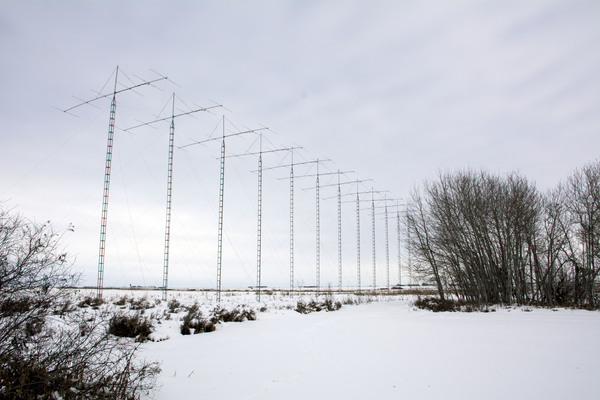
The ICEBEAR receiver site outside Saskatoon on a snowy day. Credit: Devin Huyghebaert
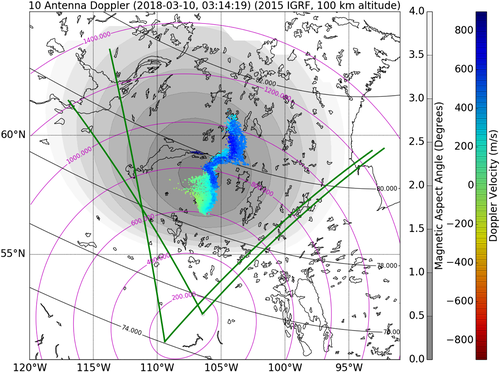
Example of the ICEBEAR field of view with some back-scatter. Figure 7 from Huyghebaert et al. (2019).
Collaborations with SuperDARN
The ICEBEAR field of view is directly inside the field of view of SuperDARN Canada's Saskatoon radar. When both are running, we can build a picture of what is happening in the E-region ionosphere thanks to ICEBEAR, and what is happening in the F-region ionosphere when the Saskatoon SuperDARN radar is running a normal control program. To the right is an example of a specially designed scan pattern for the Saskatoon radar where the radar is specifically trying to find E-region scatter in the near field of view (the area with the most overlap with ICEBEAR).
To read more about ICEBEAR, check out the paper here! and the ICEBEAR website.
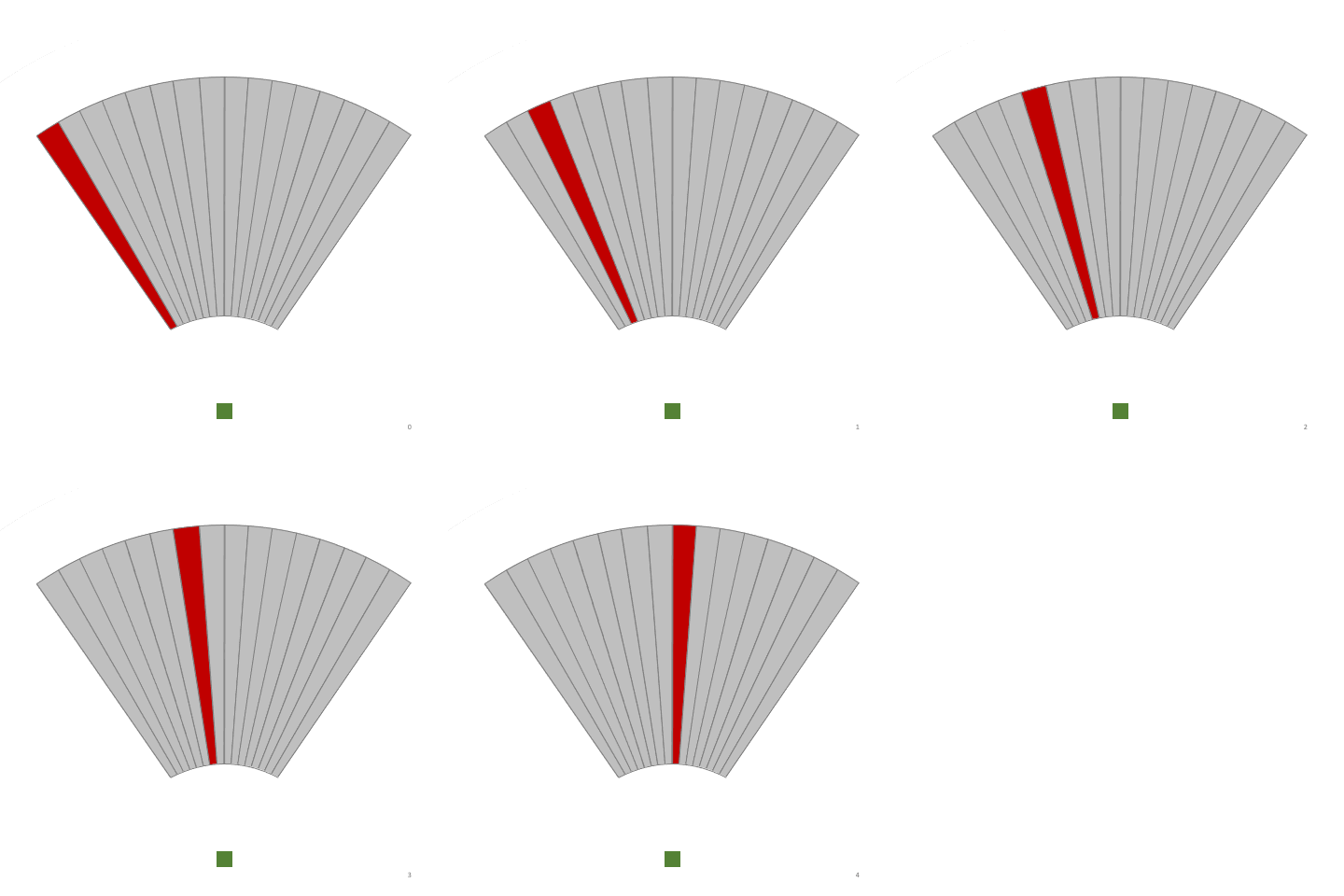
The scan pattern for the Saskatoon radar, designed to run in conjunction with ICEBEAR.