
What is Radar?
What is RADAR?
RADAR was originally developed pre-World War 1 by a number of nations for secret military purposes. It was designed to use radio waves to track enemy ships and aircraft. Nowadays, however, there are many varied and modern uses for radar systems. In addition to military defence, the most common uses are in weather monitoring: where water in the air can be tracked by radars to predict where it may rain or snow; air traffic control: where the position and speed of aircraft is calculated using radar; as well as scientific experimentation: like SuperDARN and radio astronomy.
The term RADAR was first used in the US Navy as an acronym for RAdio Detection And Ranging
The earliest experiments with radio waves being used for detecting objects were as early as 1886, where Heinrich Hertz postulated that radio waves would reflect off solid objects. Just 10 years later, Alexander Popov, a Russian physicist developed an experiment that detected far away lightning strikes. When in testing he realised this could be used for communication between two ships. However, when the ships were communicating, he noticed an additional signal coming from another ship passing between the two communicating ships. Thus, Popov could detect that there was a third boat, from the additional signal. However, as Popov was only interested in communications, he noted the phenomena and did not investigate further.
It wasn't until the early 1900's that radio waves were used to detect metallic objects specifically, and a whole host of experiments, driven by the urgency of war, were initiated to detect enemy aircraft and boats. This new found science of radar, was helped along considerably by the invention of the cavity magnetron, which generates a high power radio signal from a direct current of electricity by controlling a stream of electrons with a magnetic field. The electrons are moved between empty metal cavities in which radio waves can oscillate, the same way sound waves oscillate in the empty cavity of a glass bottle, when you blow over the opening.
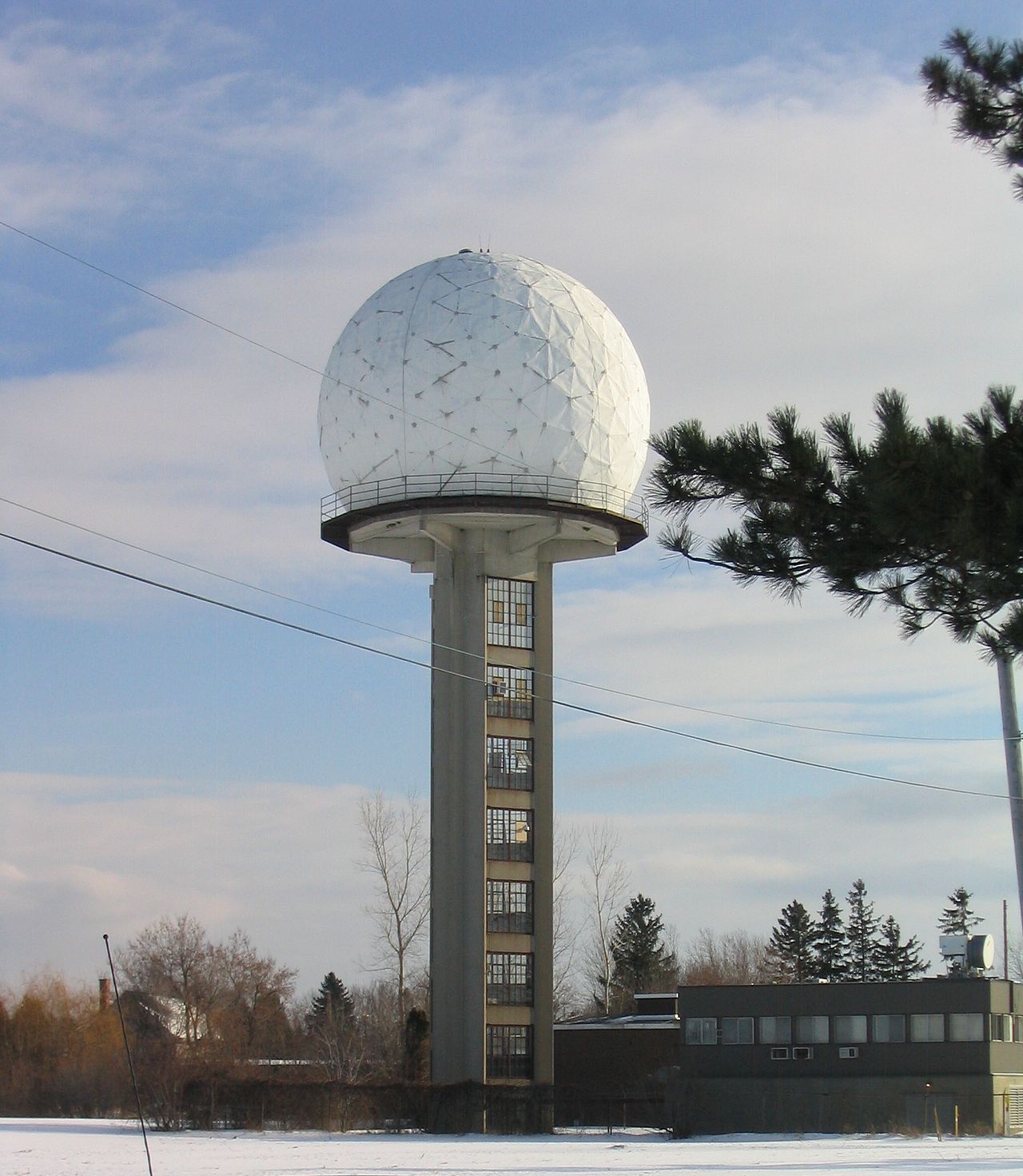
An example of a weather radar station from part of the Canadian weather radar network. This is the Tower and Radar dome of the J.S. Marshall Radar Observatory. Credit: McGill University.
This explains how we can reflect radio waves off solid metallic objects and detect a returning signal. But some of the things mentioned, like moisture in the air, are not solid or metallic. Well, as mentioned in the Radio for Beginners tutorial, when waves travelling through one material meet another, electromagnetic waves can also be scattered, or reflected off the boundary between the two materials. In early experiments, the boundary between air and a metal aircraft is very stark, and as such easier to reflect off. In modern times, we can reflect off 'surfaces' which can amount to just a sudden change in density of air molecules.
The Doppler Effect
The Doppler Effect, sometimes called Doppler Shift, is a phenomena in which the frequency of a wave appears to change due to the different velocities of the source of the waves, compared to the observer of the waves. Almost everyone will have experienced the most common example of Doppler Shift when an ambulance with sirens sounding drives towards you, and then away in the other direction. You will notice that the siren sounds lower as it's driving away frow you compared to when it was driving towards you. In acoustics, the frequency of a sound wave is directly related to how high pitched or low pitched a sound is. So as the ambulance is driving towards you, the observer, it's speed towards you is squashing or compressing the wave (so more waves reach the observer/increasing the frequency), making it sound higher pitched, and vice versa.
The Doppler Effect is not restricted to just sounds waves, all waves are at the mercy of this phenomena, in fact the entire universe is being 'red shifted' due to the Doppler Effect. Everything in the universe is expanding apart since the Big Bang, so any light we see from distant stars is 'expanded' in frequency, just like the ambulance driving away. Except, instead of pitch changing in sound waves, in the electromagnetic spectrum the frequency defines what type of wave you get (i.e. radio, ultraviolet, infrared, visible light, see Radio for Beginners tutorial) and if we see something that should be blue, it may be shifted all the way down to a red colour in visible light because of this movement. It doesn't stop there, you may have heard of the cosmic microwave background radiation. This radiation is a remnant of the big bang where all energy and waves were high frequency gamma rays, this is moving away from us so fast that we see it shifted in frequency all the way down to microwaves.
Knowing the difference in frequency between what the observer sees (or hears) and what the frequency should be, we can not only detect that an object is there but calculate the speed of the object - using radio waves, this is exactly how a police speed camera or radar gun works!
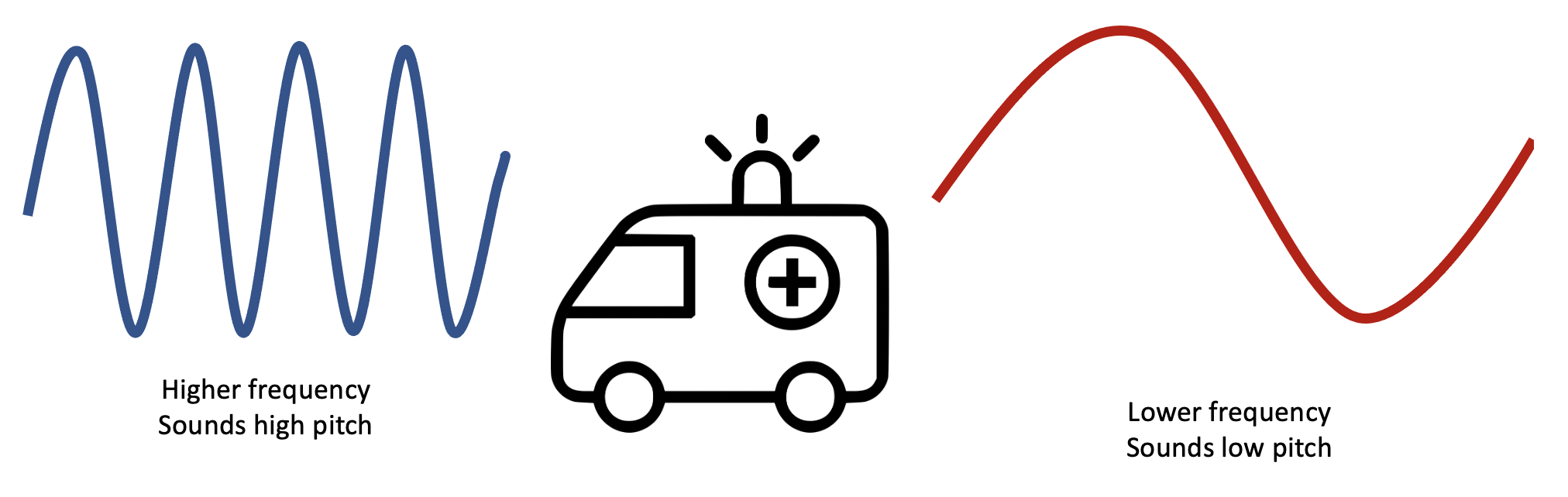
Example showing the changes in frequency of a wave emitted from an ambulance siren travelling towards the left of the image.
Measuring Distance and Speed
As we have discussed, the speed of light (c) through a medium is a fixed value. If we know how fast something is travelling, and how long it takes to get there, then we can calculate the distance it has travelled. For example, a car travelling at 100 kilometers per hour has been travelling for one hour, hence, the car must have travelled 100 kilometers. When using radio waves to calculate this, we actually measure the distance travelled twice. This is because the radio wave has to travel to the object, bounce off, and then return. Thus, we can measure how far away an object is, by bouncing radio waves off it's surface and timing how long it takes to come back.
The doppler effect, described above, is how we measure an objects speed. In a similar way to measuring the distance to an object, we also bounce radio wave off an object, but in measuring changes in the wave we can calculate the speed at which it is moving towards or away from the radio wave source. The frequency of the wave changes after it is reflected off a moving target. Hence we measure the change in frequency from the original wave to the returning wave. If the frequency is higher, the object is moving towards the radio source, if it is lower it is moving away form the source. The larger the difference in frequency, the higher the speed of the object.
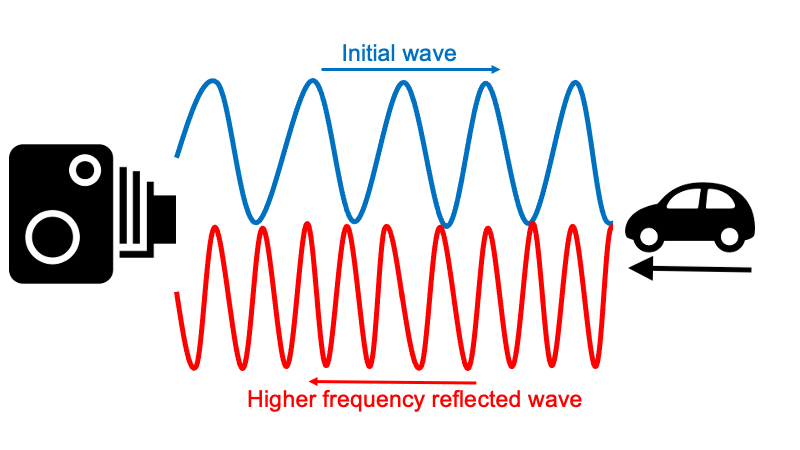
Example of a speed camera detecting the speed of an approaching car. The reflected red wave has a higher frequency due to it approaching the camera at speed.
References and Further Reading
- Encyclopedia Britannica: History of Radar
- NASA: Doppler Effect
- Encyclopedia Britannica: Doppler
- To the Moon and Back: Measuring Distance to the Moon