
An Intro to Plasma
The 4th State of Matter
In the Atoms, Molecules and Ions tutorial, we discussed the three basic states of matter. However, there is a 4th state of matter: plasma! The different states of matter are defined by how much energy the atom or molecule has. For example, you heat up (add energy to) water to turn it into steam! Increasing the energy will eventually give the electrons orbiting the nucleus of the atoms enough energy so that the electrons can break free of the forces that keep the electrons close to the nucleus. These atoms are now in the plasma state as they have been ionized.
Examples of plasmas in everyday life are lightning bolts, the aurora, neon signs and even the Sun! On Earth, we are mainly surrounded by solids, liquids and gases. But out in space, 99% of the visible universe is made up of plasmas, making it the most abundant state of matter.
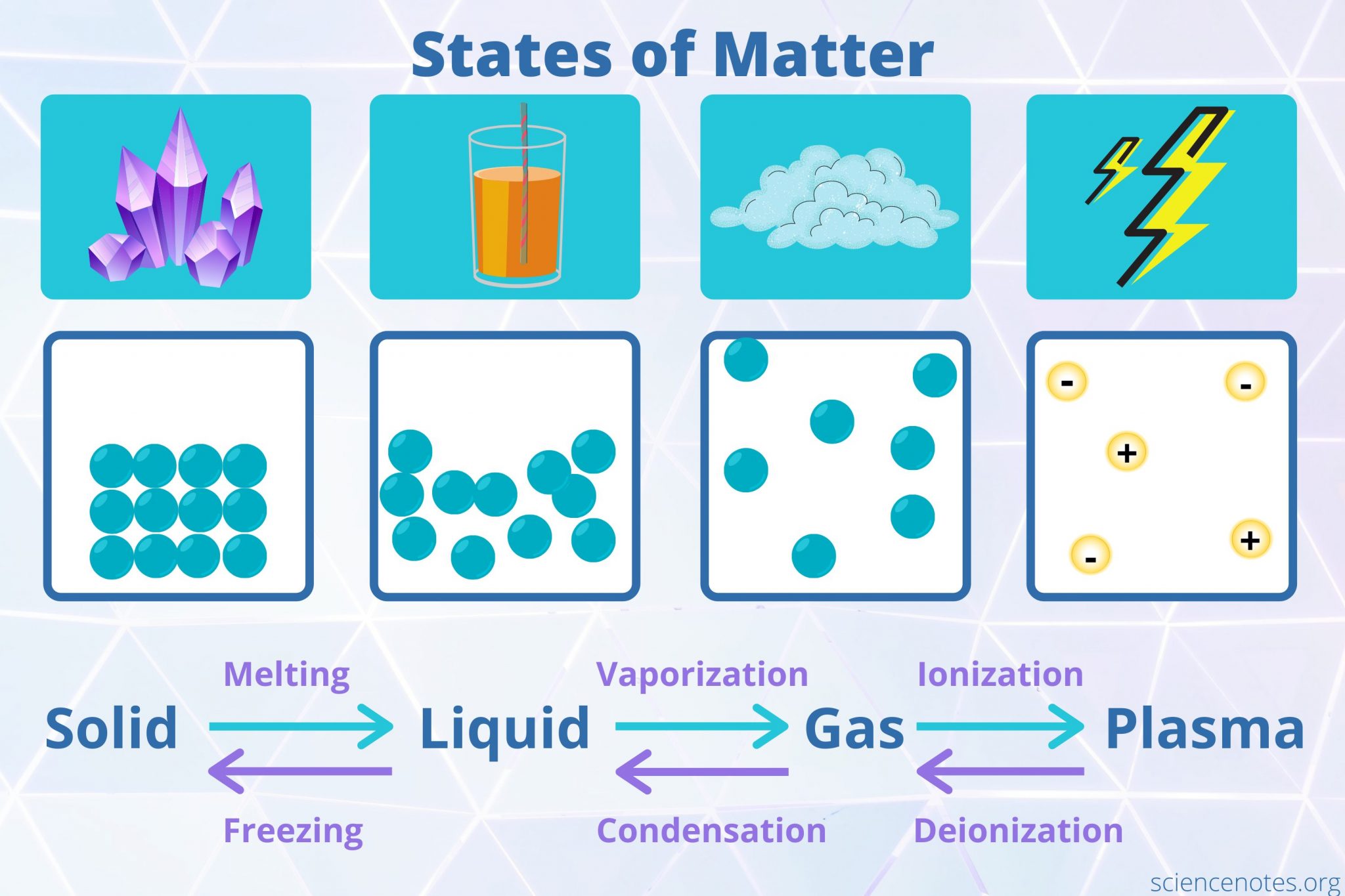
The four main states of matter are solids, liquids, gases, and plasma. Credit: sciencenotes.org
Plasma Motion (Single Particle Motion)
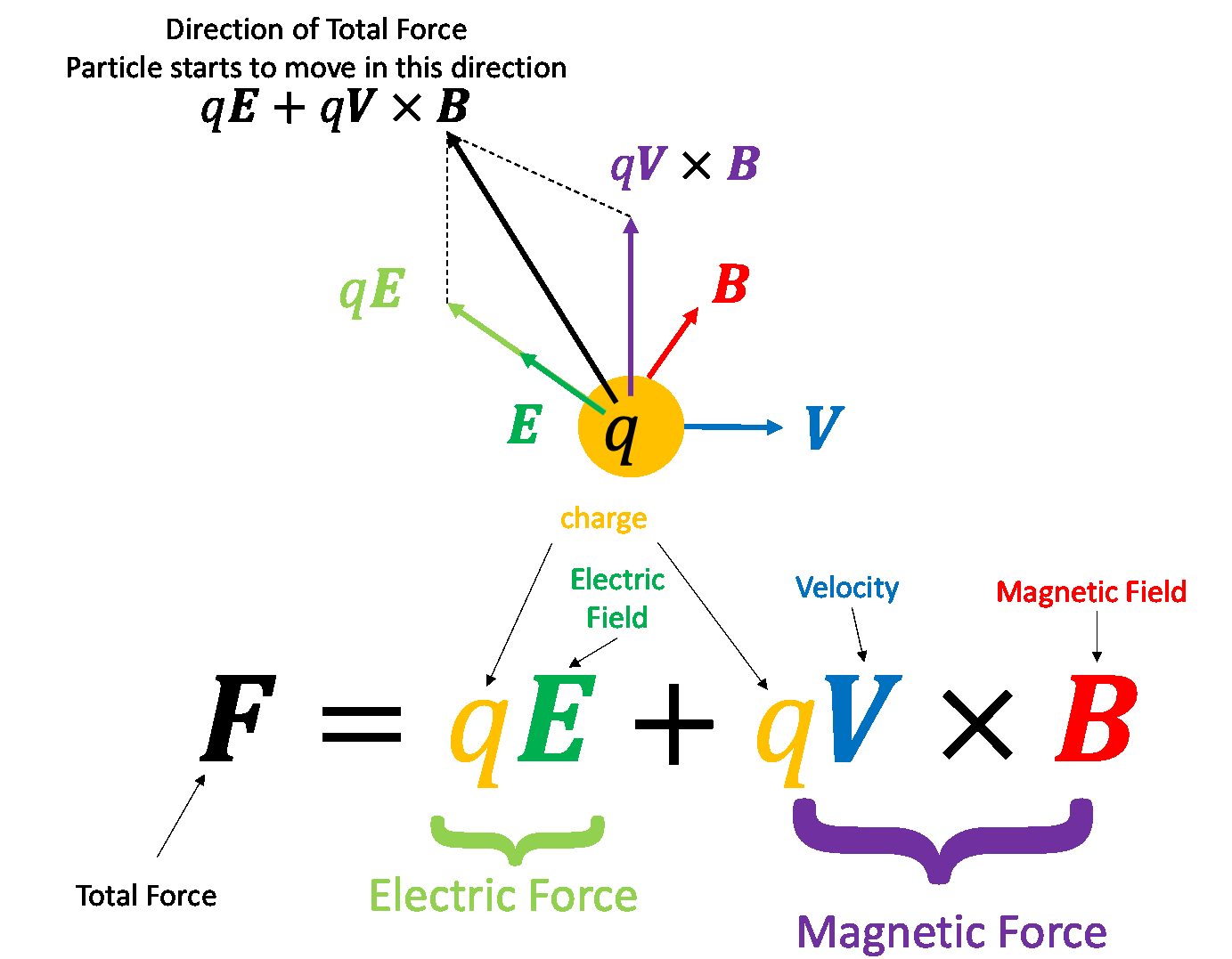
Diagram of the Lorentz Force in action.
Now that the atoms are separated into negative electrons and positive nuclei (ions), they act in many new and exciting ways. To discuss how plasma moves and behaves, we have to think about how each individual electron or nuclei move and behave. This is called single particle motion. The basis of single particle motion is the Lorentz force, a combination of the electric and magnetic forces that are acting upon the particle.
The Lorentz force acts on a particle which has a charge (q - negative for electrons, positive for ions), moves with a velocity (v), and takes into consideration if there are external electric and magnetic fields (E and B). The total force on the particle makes it move in the direction of the electric field, and in the direction of the cross product of the velocity and the magnetic field.
A cross product is a mathematical operation (like + or -) that finds the direction perpendicular to two vectors involved. For example, if we have a cross roads and two cars are crossing, one from south to north and one from west to east, the cross product of the velocity of the two cars movement would be perpendicular to both. As both of these cars are travelling along the ground, this means the cross product is straight up into the sky.
Gryomotion
When a plasma particle enters into a magnetic field, the particle feels a force from the magnetic field. The particle will feel a constant force from a uniform and unchanging magnetic field, which will result in the particle constantly accelerating (Newton's second law!). However, this force only acts on the particle if it is travelling in a perpendicular (a right angle) direction to the direction of the magnetic field.
A particle will begin to gyrate around the magnetic field, depending on its charge. Negative electrons gyrate anti-clockwise around a magnetic field line, whereas positive ions will gyrate clockwise. We call this gyromotion of a particle, and how many times the particle gyrates around in a second is called the gyrofrequency.
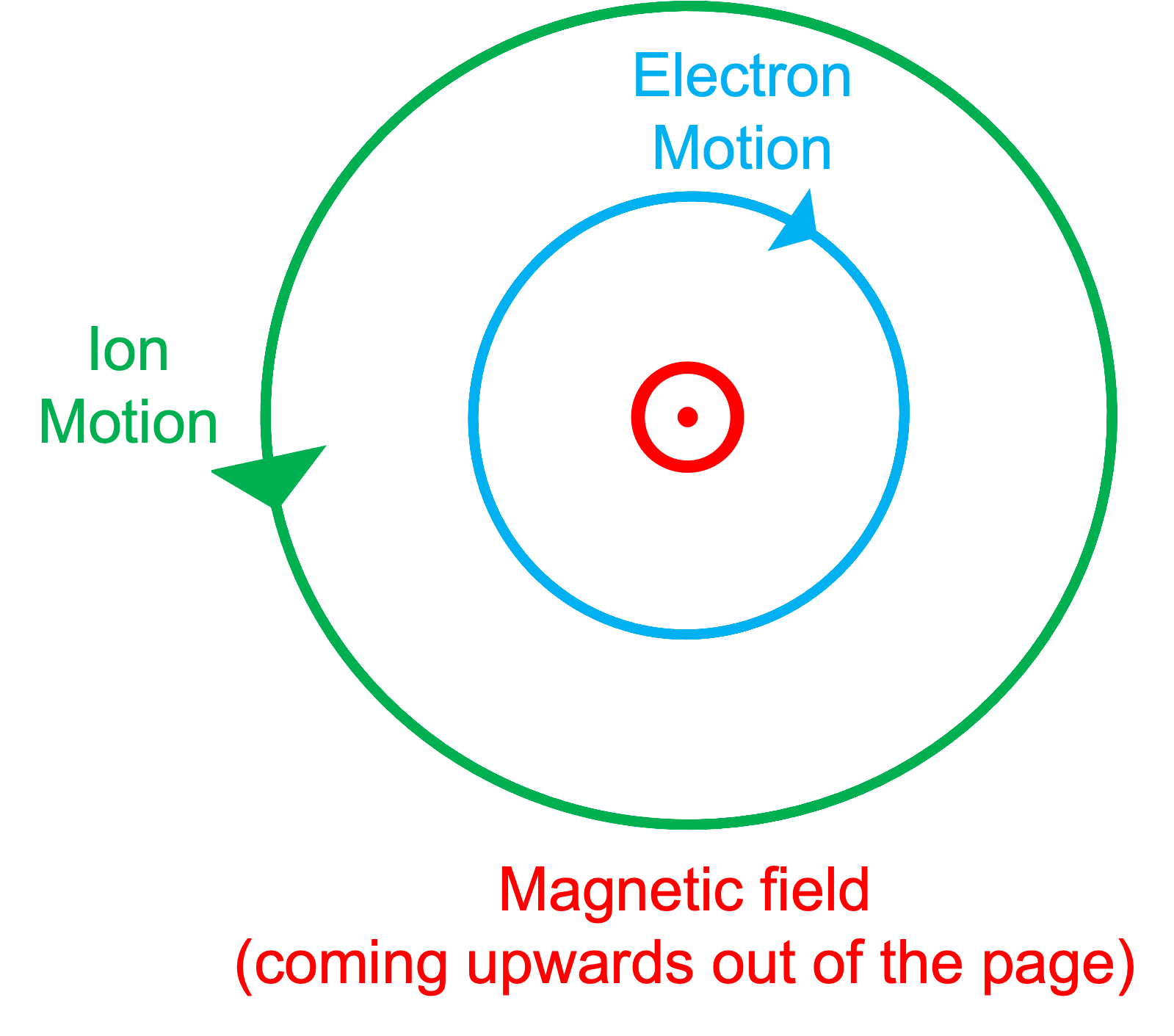
Diagram of the motion of electrons and ions around a magnetic field line.
Plasma Drifts: Making currents?
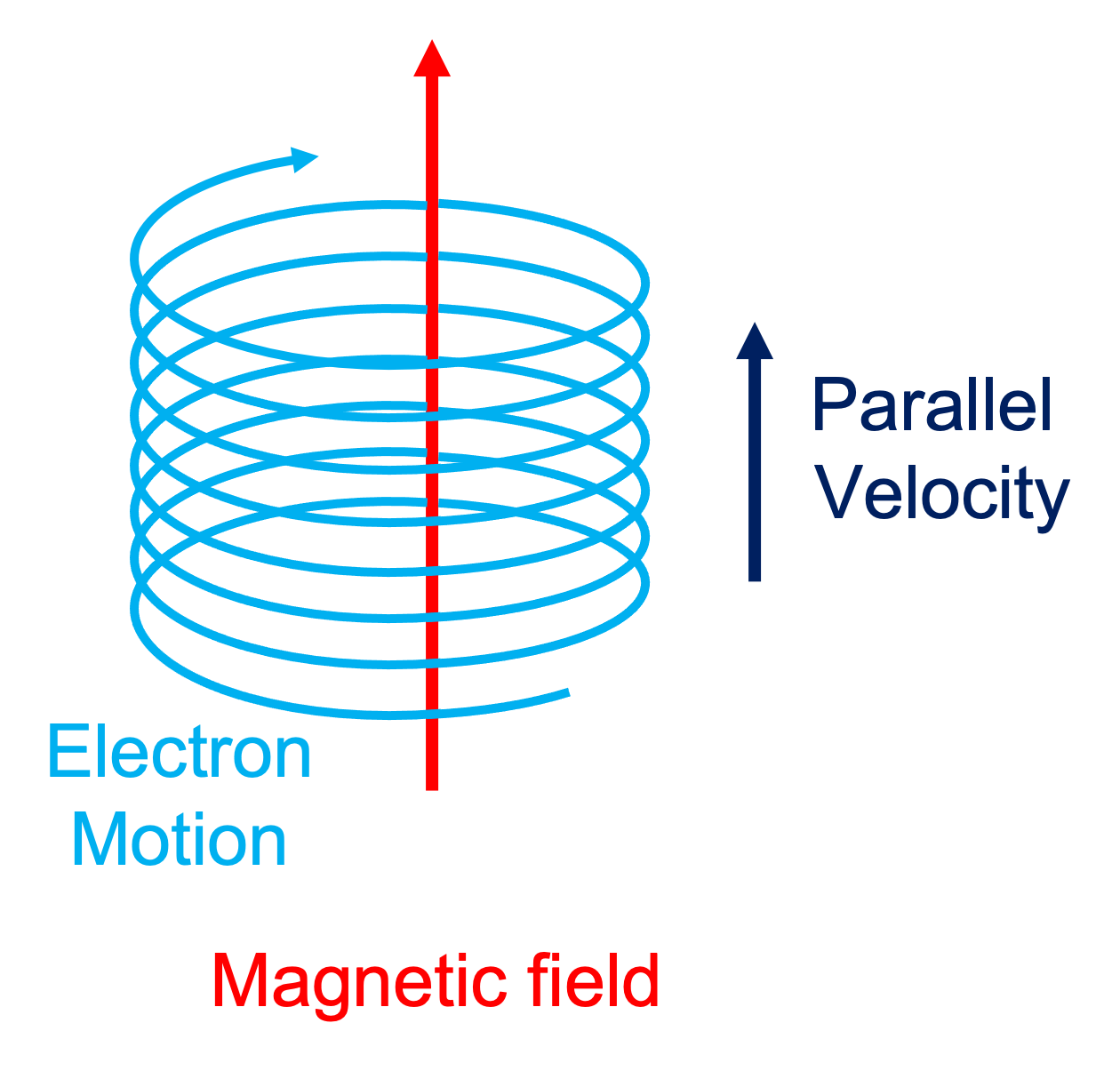
Diagram of the motion of an electron around a magnetic field line with a parallel velocity.
Now we know that the electrons and ions are moving in a circle around the magnetic field. What happens if we add in an electric field, give the particle a velocity parallel to the magnetic field, or change the strength of the magnetic field in space? We get drifts. Plasma drifts are generally any sort of average overall movement of the particles, other than the circular motion around a field line.
We see that in the case of adding a velocity parallel to the magnetic field, we can cause the particle to move up or down the magnetic field in a helix trajectory. Adding any force at a right angle to the magnetic field will cause the particles to start drifting. If we rearrange the Lorentz equation to find the velocity (and hence direction of movement of the particle), we find that the velocity is perpendicular to the force and the magnetic field, but is also dependent on the charge of the particle. Meaning that electrons and ions move in opposite directions. Hence, a separation of charge is set up, and a current can flow.
But, when adding an electric field into the situation, we are adding a force on the particle in the direction of the new electric field (qE from Lorentz). However, you can see that this force is dependent on the sign of the charge of the particle. This additional q cancels out the charge dependency of the rearranged Lorentz equation. Effectively, the force is reversed for negative particles, meaning that instead of the electrons and ions drifting in separate directions, both drift in the same direction. Hence, no separation of charges occurs, and no current is set up.
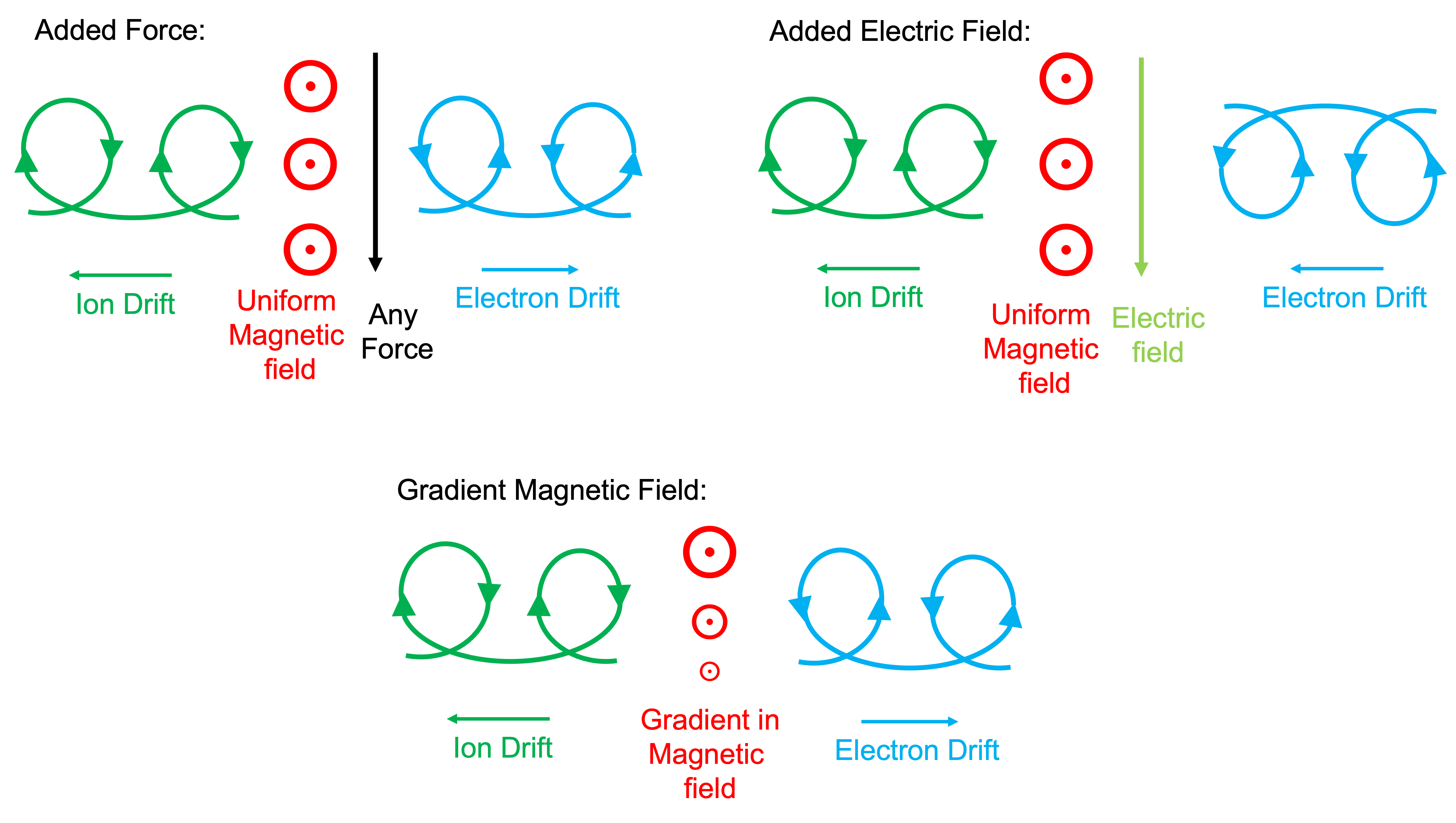
Motions of electrons and ions influenced by various fields and forces.
Lastly, what if, like in many natural situations, we have a magnetic field that has a changing strength in space? This is a magnetic field gradient, where the field gets stronger towards one direction. The size of the circle that a particle gyrates around is dependent on the strength of the magnetic field. If the particle moves into a stronger field, the circle gets tighter, and as it move to the weaker magnetic field the circle size increases. If this happens repeatedly, the particle gradually drifts in one direction. The gyration direction is also dependent on charge, and hence the electrons and ions move in different directions. This causes a separation of charge, and hence a current!
Plasma As A Fluid (Magnetohydrodynamics)
In physics, calculating and understanding the behavior of millions and millions of plasma particles is a very time consuming and computationally intensive job, even for a super computer. For this reason, we can simplify the way we look at plasma by assuming that it moves (-dynamics) much like a fluid (-hydro-), with additional behaviours due to a magnetic field (magneto-), which we shorten to MHD.
Magnetohydrodynamics is based on a series of equations about how the plasma moves in bulk (including Lorentz equation), along with the fact no mass can be created or destroyed. There are also some assumptions when using MHD, meaning that the plasma must have certain properties and must be stable and slowly changing so that MHD is a true representation of what the plasma is doing.
Credit: xkcd
References and Reading:
- Encyclopedia Britannica: Plasma
- Encyclopedia Britannica: Lorentz Force
- Encyclopedia Britannica: MHD
- Introduction to Space Physics by Kivelson and Russell