
Space Weather Impacts
Intro
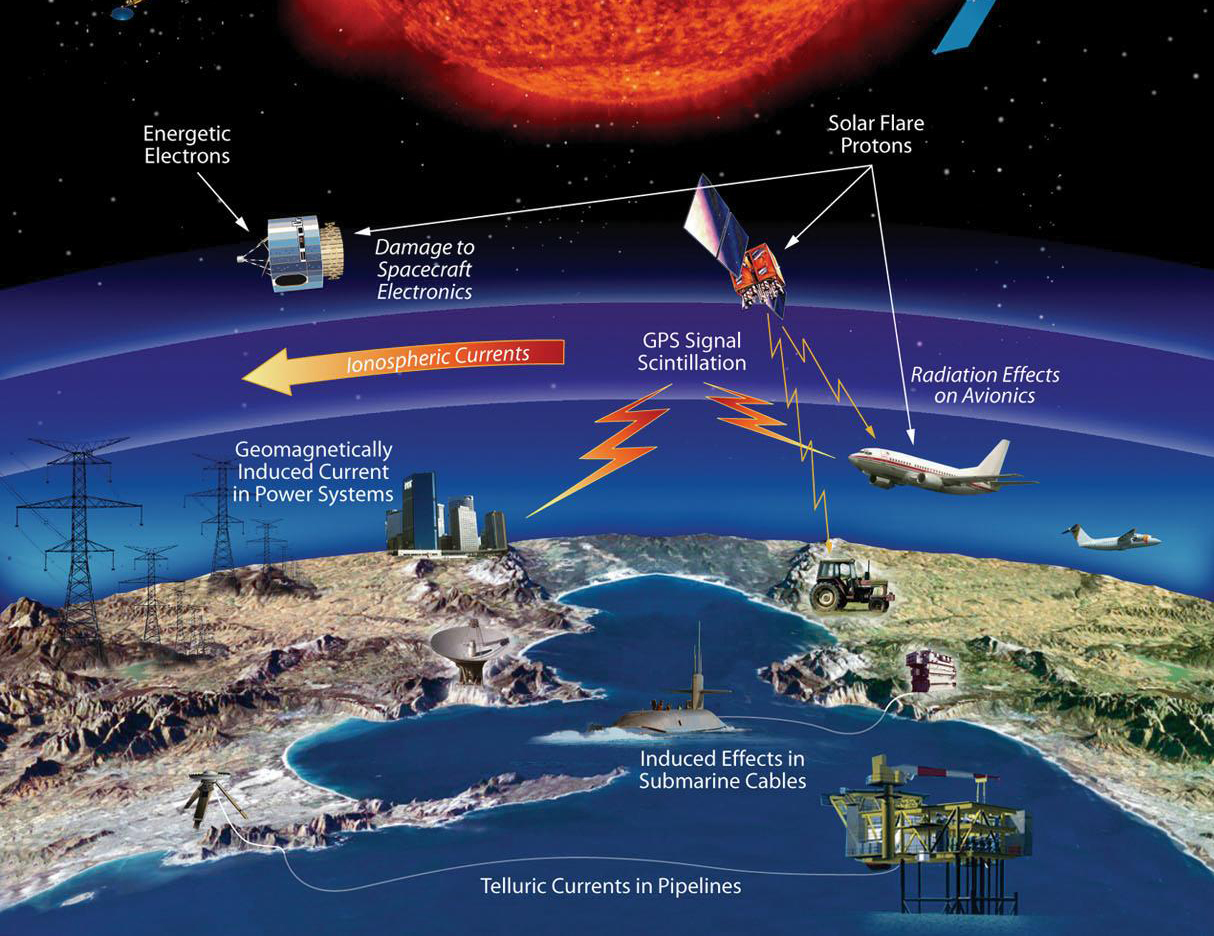
Space Weather Infographic showing the affected infrastructures. Credit: NASA
The technologically driven and dependant world we live in is vulnerable to the phenomena of near-Earth space environment. In order to mitigate detrimental effects of Space Weather, it is imperative to understand the Sun-Earth system.
Canada, as a Northern nation, relies heavily on technology that is vulnerable to Space Weather effects such as:
- Pipeline corrosion
- Damage to the electrical power grids
- Degradation of satellite navigation (e.g. GPS) accuracy
- Loss of radio communications
- Radiation from space causing polar flights to be diverted
- Damage to telecommunications satellites that facilitate billions of dollars of business every day
All of which can lead to the disruption of our modern tech-based daily lives, loss of business and livelihoods, to even loss of life in extreme situations.
An extreme example of a detrimental real-life effect of Space Weather vulnerability to Canadians is the loss of power for the entire province of Quebec caused by a large geomagnetic storm in March, 1989. The phenomena of Space Weather, however, can also be experienced safely by viewing the Aurora Borealis and Australis which is an indicator of current geomagnetic conditions.
What is a Geomagnetic Storm?
Check out our tutorials on the solar wind and Earth's magnetosphere for more background. When magnetic field lines from the Sun reconnect with the magnetic field at Earth, large transfers of energy happen within the magnetosphere. Changes in the Sun's magnetic field cause changes in the plasma, currents and magnetic field at Earth. If a southward directed magnetic field is sustained in the solar wind for several hours, this will trigger a geomagnetic storm.
The storm itself occurs when reconnection in the tail precipitates a large amount of energy and particles into the ionosphere. This creates the aurora, but it also creates large currents of electric charges moving in the ionosphere. The strongest storms are associated with heightened activity at the Sun, travelling outwards towards the Earth, such as coronal mass ejections - where large amounts of plasma with an embedded magnetic field arrives at Earth and initiates tail reconnection.
Power Grids
Electrical power grids, especially those that traverse a large distance, are especially susceptible to damage during geomagnetic storms. When a magnetic field changes in strength or moves around near a conductor (such as a long wire), this induces currents in the conductor due to Faraday's Law of Induction. The extra currents in the system can damage transformers (devices commonly used to increase or decrease voltage in the power grid to send it long distances) by causing them to heat up, which in extreme cases, can destroy the transformer and cause knock-on effects down the line of the power grid.
Power grids in North America are especially susceptible to geomagnetic storms due to their long ranging distance, proximity to the polar cap, and their tendency to be aligned along a line of latitude.

Map showing voltages induced on power lines in the USA by a large storm, compiled by the US Geological Survey (USGS). Yellow indicates about 900 V (most at risk) and dark violet about 10 V (least at risk).
GPS and Radio Communications
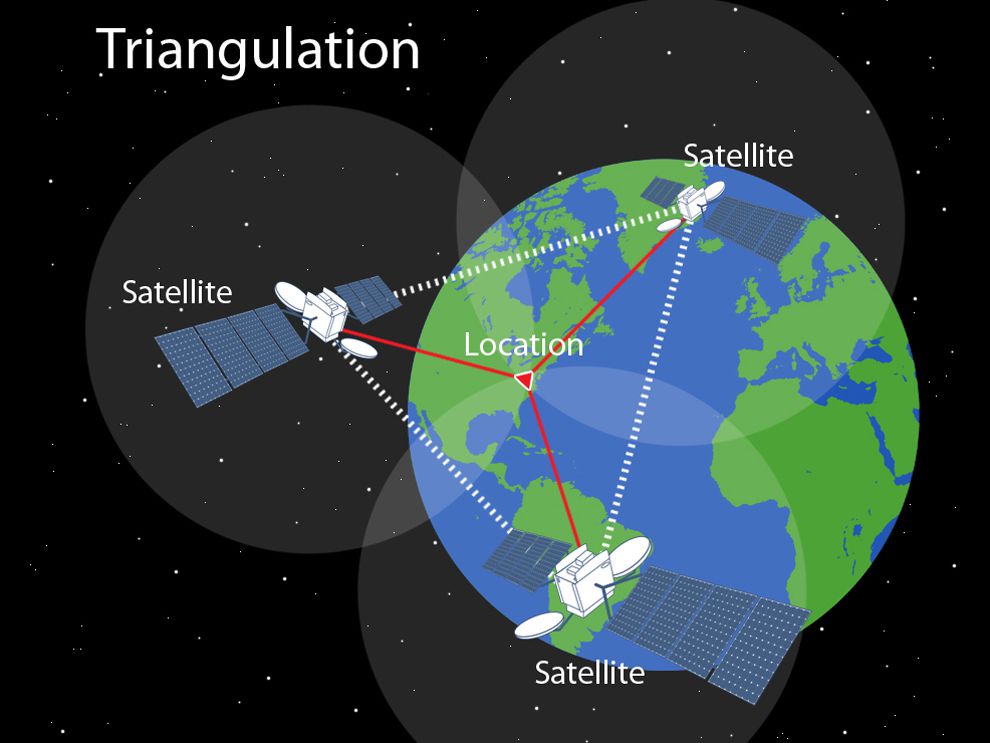
A global positioning system (GPS) device uses data from satellites to locate a specific point on the Earth. Credit: ILLUSTRATION BY TIM GUNTHER, NATIONAL GEOGRAPHIC
The global-positioning system (GPS) is used every day by most Canadians. From the obvious uses, like searching for driving directions, to keeping your clock on your phone accurate. GPS uses around 30 satellites in a high Earth orbit, so that at any one time, at least 3 satellites overlook any location and can triangulate the position of the observer.
The satellites work by transmitting radio frequency signals to a receiver on the ground. To do this it must pass through Earth's ionosphere. However, the ionosphere can bend the radio signal, just like a lens bends light, and as such can increase the inaccuracy of the positioning system. In extreme conditions, the signal can be completely lost. This can occur when a large geomagnetic storm deposits large amounts of energy into the polar cap, and increases the electron density of the region to a point where the signals can no longer be read by the receiver. This occurs very frequently in high latitude regions.
Satellites: Drag
Not only GPS satellites are affected. All satellites that are used for communications can be affected by the same phemomena. Satellites that orbit in low-Earth orbits can have the orbits themselves changed by geomagnetic storms. The geomagnetic storm increases energy input to the atmosphere, which causes the atmosphere to heat up, and expand. The atmosphere is then much denser than expected and as such the satellite can experience drag, which slows the satellite down and changes its orbit, thus causing damage and inaccuracies in its transmissions.
Flights
Air travel can be affected by geomagnetic storms in many ways. Radio blackouts due to satellites not being able to send and receive signals and flights not being able to receive signals from air traffic control are exceptionally dangerous. Geomagnetic storms also usually come with increased solar radiation. Airplanes fly very high in the atmosphere, and as such have much less protection from this solar radiation than on the ground.
Our Weather and Climate?
Even though geomagnetic storms can cause an influx of energy into the atmosphere, this all happens at very high altitudes and as such has little to no effect on our weather systems in the troposphere. Longer term variations, such as long term sunspot disappearances and low solar activity, have been correlated to cold periods in history (see Maunder Minimum), however there is no link to solar flares, CMEs or space weather to our weather or long term climate.
Protecting Ourselves
There are many simple things we can do to protect from damage due to space weather. The foremost is creating a system to give prior alerts that increased solar activity may lead to a geomagnetic storm. Space weather forecasting is a large and well defined area of research, however, there is still a lot of research to do to make it foolproof and protect lives.
For our infrastructure, implementing breaks in pipelines and power grids can stop the buildup of currents in the systems, or having switch breakers to stop the currents from moving along a power line can all help.
Flights are often redirected to avoid radio blackouts, but this requires a strong prediction service about when and where we might see issues in communications. Often, flights don't fly over the polar regions for this reason in low activity times. The main way to protect ourselves going forward is to ensure that new technologies are developed with space weather in mind, to always fail-safe in these situations and develop a suitable early warning systems for events.
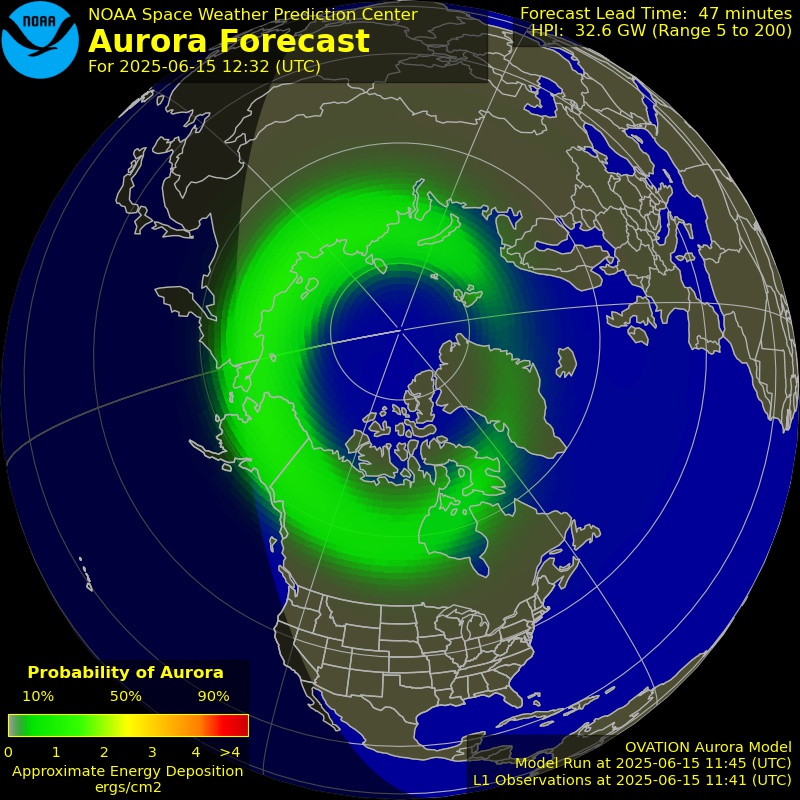
Latest aurora forecast from NOAA
References and Reading:
- CSA: Canadian Space Weather
- NASA: Space Weather
- NOAA: Space Weather and GPS
- ESA: Space Weather Effects
- NOAA: Power Grids
- NOAA: Geomagnetic Storms